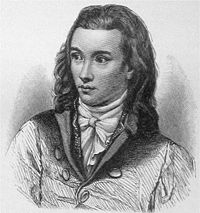
Adam Geczy: Between Virtue and Innocence
Each virtue responds to a specific form of innocence. Innocence is moral instinct. Virtue is prose, innocence is poetry.
— Novalis [1]
Long before Romanticism, poetry was thought to whisper with a sound which was the sound of Nature purified; poetry murmured with the voices of the Gods who made the world intelligible after the reign of the Titans; then no lesser a classicist than Hölderlin had his poetry be the rumour of the will of the people (Volk). Prose is poetry descended to utility, being the tool for poetry’s divine disclosures. Poetry needs prose until the world can be poetised, which is not a rendering of the world into reasonable order as Hegel would have it, but a state of beneficence, a benign chaos, about which the World’s charms (Reizen) and mysteries (Rätsel) swarm freely, where Nature becomes Art, stepping into a state of deeper imaginative concentration. This state is as much as what poetry exerts on nature as what the poetry performs on the spirit (Geist).
Poetry, for the Romantics of the turn of the century, allowed the listener to listen with an innocent ear and to see world as if it were seen for the first tim. The dream was for this curious and enlightening state of incipience to be sustained before it lapsed into prosa — straight-forwardness. But before Nature reverted to pure allegory (in which prosodic time no longer has a place) there came a series of crises in the twentieth century WWI, the Holocaust, and now Kosovo which made the aspirations of poetry, in Adorno’s word, barbaric. Although of course poetry continues to be written, it is with continued skill but a diminished audience. Prose poetry and tableau fiction is a genre, or form, or both, traceable to early Romanticism and has a currency in light of this ‘impossibility’ of poetry. It seems however that its currency is, apart from the devotees and the specialists, mostly ignored in Australia, evident in the strong reluctance to publish it. There is a polarity which exists in Australian published works and one can afford to say this categorically between poetry and narrative fiction, with an impoverished mid-way. This is a banality forcing poetry, for the wider public, to appear finer and more elite than it is, or would wish to be.
*
The mid-way between poetry and prose has several names, poetry in prose, tableau fiction, imagistic fiction or prose vignettes. If they are all slightly different, they all share the characteristic of the vignette which is another way of saying that that their commonality is a pictorial quality. This kind of writing is as if enframed, this quality visible on the page itself, floating between the lacunae of blank paper. This form seems to write the picture which is physically absent, to be in a state of continual evocation.
This form originated with the German Romantics then reached a climax with French Symbolism. While the short prose piece is evident in Psalms and classical fables, neither takes the liberties of tableau fiction, and not until the German writers of the end of eighteenth century was there anything that resembled a theory of the fragment as such. The German Romantics including Novalis, the Schlegel brothers and the associated circle of Ludwig Tieck, Wilhelm Wackenroder, Clemens Brentano and Friedrich de la Motte Fouqué all stridently defended dreams as an essential component to spiritual life. They found the fragmentary nature of dreams to be a fecund artistic and philosophical resource, an impalpable but instructive library of discontinuities. As a whole, they believed in transcendent spirit (Geist) but, bowing to the pervasive influence of Kant, they were willing to concede that Nature in its pure dynamism and diversity was permanently unknowable.
Imagery of imprecision in quite precise, though at times unconventional verse of prose, attempting to communicate the incommunicable of emotion or sensation was a philosophy which came to a climax with French Symbolism. Symbolism, the art of suggestiveness, was a form of oblique expression whose compound of image upon fragmentary image closed into an impalpable, unqualifiable shape which was somehow more real than basic demonstrative sentencing. The importance of the Symbolist poésie en prose was that the narrative element in prose was, at times, better disposed than short poetry in creating contexts to provide the bed for sensory relationships. It is also a logical outcome of free verse, and the prose poem in a sense sets a challenge to the limits of various accepted and burgeoning approaches to prose.
Outstanding among these written forms in the process of development or refinement was travel writing and writings on works of art, neither of which had anything but a peripheral and informal place a century before. With Goethe and Diderot, that is to say by the time of the mid-to-late eighteenth century, the travel record and meditations on art most noticeably register the subjective emotional input of the writer. It was a cliché for the young and usually well-to-do male dreamer to record his Grand Tour, but what distinguishes Goethe’s Italienische Reise, apart from the gifts of the writer himself, is the wealth of sensory detail, featured in small block-like fragments, accompanied by the poets sketches. This was more than a diary and more than a personal record from which to craft higher forms of dramatic and lyric verse. (Rilke was to emulate Goethe’s famous travelogue in a much smaller form in the The Florentine Diary (Das Florenzer Tagebuch) in which there is no clear delineation between observation and meditation). Goethe’s fine vignettes from Italy are considerably better than a photographic snap-shot, as they record both the event as well as the feelings and digressive thoughts it prompts.
When Diderot came to write his Salons of the 1760s it was already customary for the major artistic event to be followed swiftly by cheap volumes or pamphlets explaining and assessing the major paintings. As a matter of course, the writing for these took the form of relatively small block-like description, as the critic described his way through the rooms of the Louvre. Constituting some of his very best writing, Diderot’s Salons transcend mere pamphleteering; they are classics for the way that depth of their critical insight is coupled by sensitive perception in, at its best, ebullient, vivid prose which can reach a point of electrifying enthusiasm, where the writers claim to objectivity ceases and the vivifying effects of the immediate artistic éclat are revisited. In many cases, with his favourite painters like Vernet and Chardin and with others like Loutherbourg, Diderot would imagine himself, write himself into the landscape or forget that the objects in a still-life (usually by his beloved Chardin) existed on a two-dimensional surface; he attempted to communicate this collapse of life and art which he briefly experienced, and which he experienced more fully in the work of arts absence, which was when he wrote the greater part of these appreciations.
Goethe’s influence never diminished for the young German Romantics, yet their divergence is best captured in the difference between Wilhelm Meister and Novalis’ Heinrich von Ofterdingen which in many respects presents a response to The Florentine Diary, which he and the Jena Romantics saw as punctuating an epoch. Both are Bildungsromane (Bild means picture and Bildung is learning or education) which recount a series of events which cause the hero to relinquish the naïveté of his former beliefs. But whereas Wilhem Meister leaves the poetic world for the prosaic one, Novalis Heinrich progressively discovers that the poetic world is the only absolute.[2] Neither are written as prose poems but the breakdown of philosophical morality and artistic morality is decisive.
Novalis wrote that “the novel is at once liberated history (Geschichte) and the mythology of history.”[3] And everywhere in his writings one reads of the mixture of poetising and theorising, for only poetry could grasp the sensory data which defied reason. Even if Novalis and Schlegel may have differed in their practice and conception of the fragment, they agreed that it was the best form for this tenuous connection between the indeterminate and the determinate to eventuate. The fragment could simultaneously be subjective and objective, and as Schlegel argued was the core of any discursive form —
A dialogue is a chain, or a garland of fragments. Exchanging letters is a dialogue on a large scale, and memoirs are a system of fragments. There is nothing in form and substance resembling the fragment which is both wholly subjective and individual, wholly [ganz] objective and tantamount to a significant aspect of every scientific system. [4]
Alighting upon the comparison of an exchange of letters, a contemporary reader of this passage, itself a fragment among many published in Schlegel’s journal the Athenäum would have been reminded of Goethe’s other highly influential novel, Young Werthers Suffering (Die Leiden des jungen Werther), which is an epistolary novel, not unusual for the eighteenth century (Choderlos de Laclos’ Les liaisons dangereuses is another notable example) except that the protagonist, being a painter, tends to steer the reader toward a visual recognition of even the most abstract emotions which digress and rise out of the material descriptions; it is an affect confirmed by comments such as “What I recently said to you about painting, is just as pertinent to the written arts” (was ich dir neulich von der maleri sagte, gilt gewiß auch von der Dichtkunst), which then invites the reader to make the reverse inversion. A few lines on from this, Werther describes an impression which occurred to him on that day “Ich habe heute eine Szene gehabt,” a phrase which, I think cannot be aptly translated — “Today a scene occurred to me” rings absurd. “For what should poetry be, scene and idyll?” (doch was soll Dichtung, Szene und Idyll?) he asks, foregrounding the instantaneous, spatial nature and therefore pictorial nature of what he wishes to convey; impressions embossed (gebosselt) upon his mind. [5]
Werther was a dreamer whose perceptions of the world were greater than what the world held up to him; it was Novalis who capitalised on the notion that only the fragment could reflect the intensity of imaginative and oneiric experience, since it was a form of precise and brief containment, but it was also more than this. A dream’s imperviousness to accurate representation was for the early Novalis in particular the fundamental allegory of Nature’s unmasterable mystery which yet disclosed truthful snippets of intensities as assurances of a suprasensory energy. The almost violent brevity of the fragment could suggest an inversely greater amount of material which the medium of words in themselves signified poorly, but which needed signification for this poetic, numinous, unreal invocation to occur. Because it did not have the same inheritance of form as verse, the fragment could, feasibly, move freely across the neighbouring arts of painting and music, borrowing from each. To move across such affective regions was to mimic the extratemporal powers of dream-states for which recollection and anticipation, past and future were subsumed into the one moment, a spatial unified core. “Downward turn I to the hallowed, ineffable and beriddled night. Remote lies the world sunken in a deep grave wasted and alone is its soul,” wrote Novalis in Hymns to the Night (Hymnen an die Nacht). [6] Here his ambitions with the prose fragment are most clear. As a paean to solitary oneiric experience, about half of the poem was finally published as prose, modified from its original conception as lyric (mostly) free verse. Its coupling with traditional versification has the striking effect of accenting the way we are acclimatised to the fragmentariness of verse; with the prose, through habit of the form more than anything else, connections between disconnected abstractions are harder made.
With its references to light and the earth’s beneficence notwithstanding, the sombre, morbid tenor of this hymn cycle which did the most to feed the deathliness in the Novalis myth was a welcome release to several succeeding generations of Romantics, above all in France. Gérard de Nerval, was the first writer of note to have grasped and assimilated the part of Goethe’s legacy which lay in Novalis precocious experiments and the contributions of Friedrich Schlegel and his associated circle. Nerval, who at the age of nineteen published a fairly pedestrian translation of Goethe’s Faust, is revered for the short masterpiece Sylvie, one of those cases of isolated recognition within a generous output, much of high quality. Sylvie, whose ethereal perfection intimidated even the dauntless Genet, is a story conceived as a series of short passages each of which describes a specific scene in which the sensory details emerge as highly selective. The floating character of this narrative owes itself to the way Nerval confined himself to seemingly arbitrary associations drawn from distant recollections of a signification which is all but concealed. Agreement is close to unanimous that Sylvie, in its gentle evocative power, is among the best approximations in literature of dream that there is. Proust called it a “dream of a dream”. [7]
Proust was a serious admirer of Nerval. Proust worked with tableau fiction on a grand scale in the novel he attempted before A la recherche du temps perdu, Jean Santeuil, a sequence of remarkably small chapters each recounting a small number of transactions or sensations. In his essay on Nerval he constantly refers to the signification of Sylvie in terms of tableaux. One of the chapters in Sylvie is entitled ‘Voyage à Cythère’, a literary tableau which sets up connections with the famous painting by Watteau of the same name. Here Nerval’s allusion to Watteau is telling, apposite to the unruffled, airy stillness of each prose tableau which surrounds it. Watteau’s paintings are typified by a timelessness, a kind of stasis in action; there is no progression, and the movements he depicts are without vectors; his figures remain agreeably still, eternally ready for what will never happen. Writing on Watteau Proust commented that each figure is “always frozen in a life of mist, a soul in love with light and colour.” [8] What attracted Proust to Monet concerted attention to form which remains indiscernible and imprecise lured him to Nerval in his entranced fixation on scenes of an intimacy which yet remains impalpable, unreachable. Nerval in Sylvie wrote that Proust “strove laboriously to define himself to himself, to clarify obscure nuances, profound laws, the almost ungraspable impressions of the human soul.” [9] The Romantic Agony is in embarking upon a quest which cannot be achieved. Sheer shortness of length and the whites of the page between each fragment, like innocent, non-ornate frames, attest to zones of aphasia, blindness and inarticulability; for Nerval, as it was for Watteau, the embarkation to or from (for the painting actually has two titles) Cythera will never be accomplished, it remains locked within the frame of the picture.
The bridge between Nerval’s later work and Baudelaire’s prose poems, the Le Spleen de Paris (1869) is Aloysius Bertrand’s Gaspard de la Nuit (1842), once again short sequences dedicated to a free-roving solitary subject, oscillating between testimony, observation, exaggeration and airy dream experience. Bertrand subtitled his suite of prose poems, ‘Fantasies in the manner of Rembrandt and Callot’ [10] the first a master of rich tenebroso, the second of the grotesque, best known for his graphic images of the commedia dell’arte in France at the beginning of the seventeenth century. In the dedication at the opening of his prose poems, Baudelaire confesses to emulating Bertrand while emphasising modern life. “Who has not” Baudelaire asks, “during one’s more ambitious days (dans les jours d’ambition) dreamed of a miracle of poetic prose (une prose poétique), musical without rhythm or rhyme, and as supple and abrupt in its adaptation to the lyrical stirrings (mouvements) of the heart, to the amplitudes (ondulations) of reverie, to the flights of consciousness.” [11] No less than Les Fleurs du mal merges beauty with horror in a harmonious lyric form, Baudelaire wanted to return the higher art of poetry to the street back to the mundanities implied in prose. In both cases he wanted to defile poetry without ever having to lose his love for it, which means to enjoy decay without ever having to relinquish beauty. The prose poem is not a nexus between poetry and prose, as if the two were reconciled, rather with the poetic prose fragment the poetised moment tends to remain in the world, whereas traditional poetry is a gesture of sublation. The Hegelian tradition sees poetry as the highest of the arts because it is the most disembodied and conceptual; prose poetry and fragments share some of these interests but celebrate the disadvantage of actively partaking in the other arts painting, music as opposed to perfecting them.
*
“A few moments before I rose I actually heard you dreaming, the breathing getting suddenly deeper and more rapid as you fled something or ran after it down one of the lanes or alleyways, deep in the ancient city of the mind. ”
— David Brooks [12]
Why there is such a dearth of support for prose poems, poetic fragments and tableau fiction in Australia is perhaps best approached with a statement about the beginnings of visual art in this country. Bernard Smith opens the first major study of Australian art, Place, Taste and Tradition, with “In older countries art has usually been, at its beginnings, the handmaiden of religion, but in Australia it first waited upon science.”[13] An analogous observation might be made of Australian writing. It is remarkable that our earliest poetry is dominated by narrative verse with a strong leaning toward quickly cultivating a folkloric tradition. Romanticism had made of folklore artistic content as the Græco-Roman myths; by appealing to local lore, the poet was able to stress his tie with his immediate place, and the continuity of his voice to that of the many, which folklore, as an inheritance of illiterate groups, enshrined. Hence, with the aim of fostering a language which could be shared, epic and lyric on one hand, the radicality of prosodic poetry on the other hand, had no place. And it is only in the last twenty or so years that the greater urbanised reading public do not feel the same urgency as before in having to read about the country which it does not and is indeed disinclined to inhabit. Nevertheless the comfort of reading about ones place instating a history and making up for lost time, has left a vast hole in Australias artistic habits which are loath to nurture this form except in literary journals and quarterlies. For the genre of the fragment is not necessarily experimental in the use of the term to mean opaque writing for specialists, though it is branded as such, despite the continental tradition of this approach and continued use of this form by eminent exponents such as Deguy and Ashbery, and by many younger poets in Germany where formal lines are increasingly, as Baudelaire had wished, suppler.
I will end with a recent work by Nicolette Stasko who, with David Brooks and Gail Jones, is among the leaders of this form in Australia. In all three writers the debt to Continental Romanticism leading up to Symbolism is well evident. All have a strong tendency toward the visual and in some cases, the oneiric, yet there is a notable development in the visual referent for all three writers in that, while all three appear to be deeply moved and influenced by all forms of painting as well as the decorative arts, there is now the overwhelming presence of photography, as if they had kept the form and genre up-to-date since the end of the nineteenth century. It is a presence ubiquitous not exclusive to this form: John Ashbery’s extraordinary Three Poems are more like poetico-philosophic ruminations, fluctuating between declamation and mellifluous inner mumbling, and Deguy works more with the tension between the concrete force of words and sounds and their meaning as the successor to the examples of Mallarmé, Jacob and Apollinaire.[14]
Contrastingly, once the cover of Stasko’s most recent book, The Invention of Everyday Life is closed, and one looks up from the words, one feels as if one has just read a photo-essay. It is a Spleen de Paris but anonymously suburban and without the spleen. It is a prose composition of a female flaneur (though her protagonist is in fact male) in what could be any Australian city, and her mundane prosaic observations are about whatever one goes about in living; living at its most elementary: walking, shopping, staring out the window, passing people on a bench; what occurs when one passes someone more than once, and so on. Its art is not only in what is observed but the skill with which the entire book is assembled, like installing a large photographic suite in a difficult, demanding, at times inhospitable exhibition space.
The preface bears this out. It tells of a mildly strange and solitary woman photographer. It is as if the authors verbal visions are what is lasting of what the author herself saw as lasting, the eccentric photographers pictures, plastered randomly in the dusty window of her ‘modest studio’. The author/narrator is ‘intrigued’ and follows her, first unobtrusively then to encounter friendship. He is given a keepsake before her death. Shortly afterward the narrator convinces the photographers sister, arguing to her that they will only sit around and deteriorate, to surrender the copious, disordered remainder of the photographs — “It was difficult to believe that anyone could have produced an enormous quantity of work that, from what I could tell, nobody had ever seen.” The reader of course never sees them and the author professes to inhabit them, colonising them verbally, travelling through them as a guide and the fragmentary character of the rest is revealed to any sensitive reader:
Inevitably, as with a doppelgänger, our two personalities merged, one a shadow of the other, inhabiting the same places, sentences, words, images. After long hours there were times when I began to be unsure as to which of us was myself and though I have attempted to be scrupulous in the following, I have no doubt that it contains (and reveals) almost as much of myself as of her. And always, as long as I stayed in that place [the place in which the book is set], something clamoured to be added, I make no apologies for this. [15]
The narrative, if it can be called that, better a constellation or archipelago, describes a double search. The first, the narrator’s self-assertion within a sphere of existence which is largely inconsequential; the other a hypothetical tracery of hunches and suppositions based on a medium which is of her own; to make relevant, to consummate perhaps, the images which would have been discarded or would have moulded away, or if preserved, whose meanings would have dissipated as all precise meanings do. Stasko’s narrators effort of twofold restitution does not, she/he knows, restore anything. The success of the book is, paradoxically, to register the opposite. Exploring the small moments through and between these photographs, as he jitters between a morass of partial records, petrified moments, the minor and paltry deaths which are photographs, the narrator intercalates into them his own transient (verbal) records only to confirm despite this twofold gesture of preservation that there is still alienating chaos in the midst of order-making art. Art may be order prized from chaos maybe. The terse and nimble violence of the fragment is a concession to the order which art must have but, by ripping it slightly apart, it leaves room for instability and with it, a dangerous liveliness.
Footnotes
1. Novalis (Fredrich von Hardenberg) Fragmente aus den Schlegel-Tiecksichen Ausgaben, §326, in Novalis Werke in Zwei Bäden, Cologne 1996, 2: 247—8.
2. See also Jean Hippolyte Genèse et structure de la Phénoménologie de l’esprit de Hegel, Paris 1946, 16—7.
3. Novalis, op. cit. §405, 2:266.
4. Friedrich Schlegel, Athenäums Fragmente (1798), in Kritische und theoretische Schriften, Stuttgart 1978, 85.
5. Johann Wolfgang Goethe, Die Leiden des jungen Werther (1775), Zürich 1986, 17—8.
6. Novalis, Hymnen an die Nacht (1799—1800), Werke in Zwei Bäden, I: 109. Published after his death by Schlegel and Novalis’ brother Karl. Sources conflict as to the exact format they should have taken. See also Wm. Arcander O’Brien Novalis. Signs of Revolution Duke U.P. 1995, 256—71.
7. Marcel Proust, ‘Gérard de Nerval’ (1907—8), Contre Sainte-Beuve, Paris 1971, 237.
8. Proust, ‘Watteau’, Contre Sainte-Bauve, 667.
9. Proust, ‘Nerval’, op. cit., 237.
10. Aloysius Bertrand, Gaspard de la Nuit (1842) Paris 1980. See also Max Milner’s preface to this edition, 7—52, and the author’s preface (79) where the relation to the two-dimensional art is decisive: ‘yet here, besides fantasies in the manner of Rembrandt and Callot, studies after van Eyck, Lucas of Leydon, Albrecht Dürer, Peeter Neef, Breughel of Velours, Breughel of Hell, Van-Ostade, Gerard Dow, Salvator Rosa, Murillo, Fuseli and many other masters of different schools.’
11. Charles Baudelaire, ‘À Arsène Houssaye’, preface to Le Spleen de Paris (1867), Oevres complètes, Paris 1984, 382.
12. David Brooks The Dead Sydney 1999.
13. Bernard Smith Place, Taste and Tradition (1945) Oxford U.P. 1979, 33.
14. John Ashbery Three Poems (1970) New York 1989; Michel Deguy, Poèmes II, 1970-1980 (Tombeaue de Du Bellay, Jumelages, Donnant Donnant), Paris 1986.
15. Nicolette Stasko The Invention of Everyday Life, unpublished manuscript, 1998, 7.
This entry was posted on Thursday, February 1st, 2001 at 3:59 pm. You can follow any responses to this entry through the RSS 2.0 feed. Both comments and pings are currently closed.